Read a complete chapter
Which AI idea
should you build first?
Chapter 2 · Picking Your Battles
The CEO wants “AI everywhere by Q3.” Dana, his VP of Product, needs a first move she can defend.
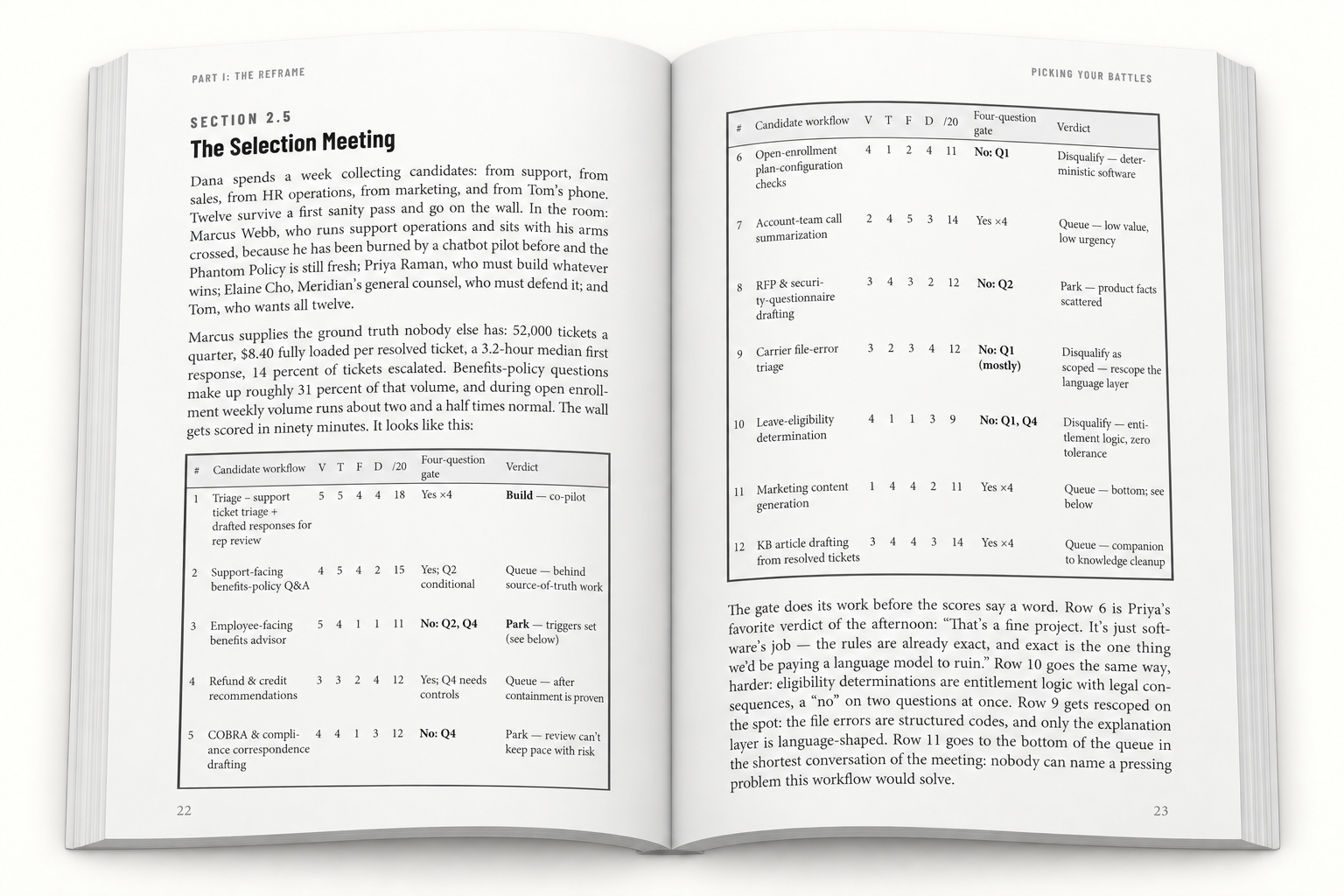
Follow the team from a wall of competing ideas to one chosen workflow. Leave with a way to decide what to build, what to queue, and what to park.
How the book teaches
A story you can follow.
A discipline you can use.
Across one year, Meridian — a fictional benefits-software company — learns to build and operate AI. Each chapter pairs the story with practical frameworks, working artifacts, and five things to do Monday morning.
The chapter guide
One year. Thirteen decisions.
Read in order, or expand a chapter to find the discipline your team needs next.
Part I
The Reframe
Choose the work before choosing the technology.
01Core AI Literacyp. 1
Understand what language models do, how they fail, and which controls your team owns.
02Picking Your Battlesp. 15
Turn an AI wishlist into a ranked portfolio, with one first workflow and clear reasons for what waits.
03Model Choice Is a Posture, Not a Pickp. 29
Compare models against your constraints, record the evidence, and plan for a future change.
Part II
The Control Levers
Specify behavior. Prove it. Keep it under control.
04Prompts Are Specsp. 43
Replace a vague prompt with a versioned contract: boundaries, evidence, refusal paths, and an output schema.
05Evaluationp. 61
Build a golden dataset, separate release gates from softer scores, and measure behavior over time.
06Prompt Opsp. 77
Give changes owners, staging environments, approval rules, and a rollback you can rehearse.
07Groundingp. 89
Connect answers to knowledge with owners, effective dates, access rules, and measurable retrieval quality.
Part III
The System
Design the product around the model.
08Architecture & Integrationp. 107
Build for latency, outages, exceptions, and the trace that explains what happened.
09The Human Interfacep. 121
Design for real human attention: show uncertainty, prevent rubber-stamping, and learn from corrections.
10Tools, Agents & the Autonomy Ladderp. 139
Put actions behind enforceable boundaries and earn each increase in autonomy with evidence.
Part IV
The Operating Envelope
Make the discipline sustainable.
11Enterprise Risk, Ethics & Compliancep. 157
Turn governance into controls and evidence your team can produce when a customer asks.
12Economics of AIp. 173
Connect cost per run to business outcomes and build an argument finance can examine.
13The Operating Playbookp. 187
Bring the work together in a repeatable cadence, clear ownership, and a one-page operating standard.
Plus the QuickStart, six appendices, and a companion library of templates.
Put it into practice
Take the ideas into your work.
The companion library holds the templates behind the discipline.
Your next chapter
Make the next decision
a better one.
A practical discipline to bring back to your team.
Paperback · Hardcover · Kindle
Find your edition on amazon.com